Flexibility for gymnastics: six muscle groups to stretch and how often
 Save
Gymnastics demands range of motion that everyday movement rarely asks for. The splits, bridges and overhead positions you see in routines come from consistent stretching of the hamstrings, hip flexors, shoulders, back, calves and wrists—six areas that bear the load in most skills. This guide explains which stretches serve those groups, how to progress without injury, and how often your body needs that work. By the end you will know how to build a stretching routine that fits around your training, not against it.
Astral Acrobatics covers the practical side of learning gymnastics and acrobatics in the UK, written for anyone training at home, in a club or thinking about starting.
The six muscle groups that gymnastics stretches hardest
Hamstrings run down the back of your thigh and control how far forward you can fold your torso over straight legs. Tight hamstrings limit pike positions on floor and beam, and make straddle splits uncomfortable.
Hip flexors sit at the front of your hip and lift your knee toward your chest. When they are short, backbends feel pinched in the lower back and front splits stop halfway. Releasing tension here takes the strain off your spine during bridges and walkovers.
Shoulders need freedom in every direction. Handstands call for overhead flexion with your arms beside your ears; floor tumbling and bar swings ask for internal rotation when your arms are behind you. A shoulder that cannot move through its full arc forces compensation elsewhere, often in the wrists or lower back.
The back—particularly the thoracic spine between your shoulder blades—extends during backbends and flexes during forward rolls. Stiffness here transfers stress to the lumbar region, where the vertebrae are less suited to repeated deep bending.
Calves attach your heel to the back of your knee. Short calf muscles pull your heel off the ground in a squat and limit the ankle flexion needed for a clean landing. Gymnasts who skip calf stretching often feel tight Achilles tendons after jumping.
Wrists bear your bodyweight in handstands, cartwheels and floor skills. The joint needs both flexion—palm toward forearm—and extension—back of hand toward forearm. Without it, wrist pain becomes the first thing you notice in a handstand hold.
Safe stretching progression: warm tissue first, then lengthen
Cold muscle resists stretch and tears more easily. Start every session with light movement that raises your heart rate and warms the areas you plan to stretch. Jogging on the spot, arm circles and leg swings prepare tissue without fatigue.
Static stretches—holding one position—work best after warm-up or at the end of training. Move into the stretch slowly until you feel gentle tension, not pain, then hold without bouncing. Bouncing triggers a reflex that tightens the muscle you are trying to lengthen. Breathe steadily; tension rises when you hold your breath.
Progress comes from small, repeated efforts. Pushing too far in one session damages fibres and sets you back. Aim to feel a stretch, not to force a shape. Your range will increase as your nervous system learns the position is safe. How to warm up properly before gymnastics explains the phases that prepare your body for skills and stretching.
How often to stretch for gymnastics
Flexibility improves fastest with frequent, shorter sessions rather than occasional long ones. Stretching three to five times a week gives your body enough stimulus to adapt without constant soreness. Each session can last between fifteen and thirty minutes, depending on how many muscle groups you address.
Some gymnasts stretch lightly every day, others rest two days a week. Rest matters because tissue rebuilds and lengthens during recovery, not during the stretch itself. If you feel sore in a muscle group, give it a day before stretching that area again. Soreness from stretching is common when you begin; sharp pain is not, and it means you have gone too far.
Timing within your training session also counts. Dynamic stretches—controlled leg swings, arm circles—fit into warm-up. Static holds belong at the end, when muscles are warm and you have time to relax into each position. Stretching cold tissue before skills raises injury risk.
Stretches that target the six areas
Hamstrings
Sit on the floor with both legs straight in front of you. Hinge forward at your hips, keeping your back flat rather than rounding your spine. Reach toward your toes, feeling the pull along the back of your thighs. Hold for twenty to thirty seconds, then release.
For a standing version, place one heel on a low bench or step, keep that leg straight and fold forward from the hip. Repeat on the other side.
Hip flexors
Kneel on your right knee with your left foot flat in front of you, knee bent. Push your hips gently forward until you feel a stretch at the front of your right hip. Keep your torso upright; leaning back reduces the stretch. Hold, then switch legs.
A deeper option: from the same position, reach your right arm overhead and lean slightly to the left. This adds a side-body stretch that reaches the hip flexor attachment.
Shoulders
Stand facing a wall, place both palms flat against it at shoulder height, and walk your feet back until your body forms an L shape. Let your chest sink toward the floor, stretching the front and top of your shoulders. Keep your arms straight.
For internal rotation, lie on your back with your arms out to the sides, elbows bent to ninety degrees. Let your forearms fall toward the floor behind your head, feeling the stretch across the front of your shoulders.
Back
Lie face-down, place your palms under your shoulders and press up, lifting your chest while keeping your hips on the floor. This stretches the front of your torso and extends your spine. Hold without straining your lower back.
For forward flexion, sit with your knees bent and feet flat, then round your spine and reach your arms forward, tucking your chin. This stretches the muscles along your back.
Calves
Stand facing a wall, place your hands against it, and step your right foot back. Keep that heel on the ground and your leg straight, then lean forward until you feel the stretch in your right calf. Repeat on the left.
To reach the deeper muscle near the Achilles tendon, bend the back knee slightly while keeping the heel down.
Wrists
Kneel with your palms flat on the floor, fingers pointing toward your knees. Lean back gently to stretch the front of your wrists. Then flip your hands so the backs rest on the floor, fingers still toward your knees, and lean forward for the opposite stretch.
Wrist circles and gentle rotations between stretches keep the joint mobile.
Mistakes that slow progress or cause injury
Bouncing in a stretch activates the muscle's stretch reflex, which contracts the fibres you are trying to lengthen. Small, pulsing movements feel productive but work against you. Hold still instead.
Holding your breath raises tension throughout your body. Tight shoulders and a clenched jaw make every stretch harder. Breathe slowly and let your exhale soften the position.
Skipping one side happens when a gymnast focuses on the weaker leg or the side a skill favours. Imbalance between left and right creates uneven loading during skills and raises injury risk over time. Stretch both sides equally, even when one is already flexible.
Stretching through sharp pain damages tissue. A stretch should feel like gentle pulling, not stabbing or burning. If pain appears, ease off immediately. Soreness the next day is normal; pain during the stretch is not.
Splits training: a step-by-step approach
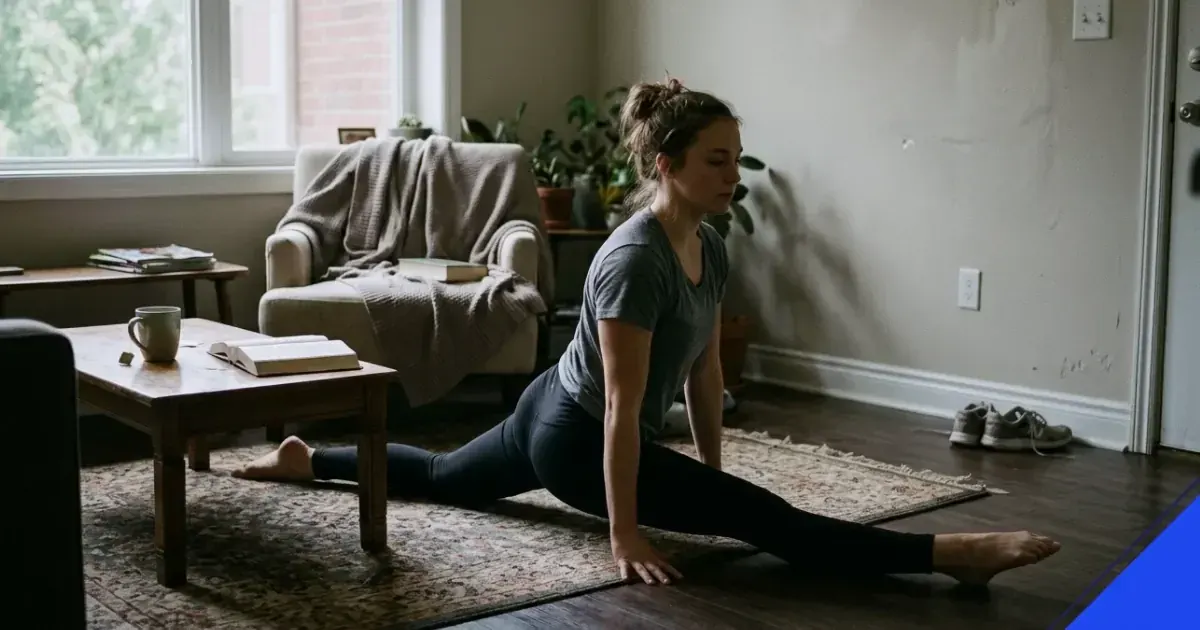
Front and side splits are common goals, and both require patient, consistent work. Rushing into a full split before your muscles are ready strains the hip and hamstring attachments.
- Warm up with leg swings, lunges and gentle forward folds until your legs feel loose.
- Kneel in a lunge position with your back knee on the floor. Slide your front foot forward slowly, lowering your hips as far as comfort allows. Support your weight on your hands or blocks beside your hips.
- Hold the position for twenty to thirty seconds, breathing steadily. Your muscles will relax slightly as you hold.
- Return to kneeling by pulling your front foot back. Repeat on the other side.
- Over weeks, slide your front foot a little further each session. Progress is gradual; some people reach a flat split in months, others take longer.
- Once you can lower your hips to the floor, work on squaring your hips to the front and pointing your toes. These refinements matter in routines.
Side splits follow a similar pattern: stand with your feet wide, turn your toes forward, and slide your feet apart slowly, supporting your weight on your hands in front of you. Lower only as far as you can control, then hold.
Stretching routines for different training schedules
A gymnast training four or five times a week fits stretching into the end of each session, covering two or three muscle groups each time. One day might focus on hamstrings and calves; the next on hip flexors and back. By the end of the week, all six areas have been worked.
Someone training twice a week needs slightly longer sessions to give each group enough attention. A full-body stretch routine lasting twenty-five minutes covers everything in one go.
Home practice between gym sessions keeps progress steady. The equipment that makes home practice safer includes mats and supports that help you stretch without discomfort. Even two short sessions at home add up over weeks.
| Training frequency | Stretching structure | Session length |
|---|---|---|
| Four to five gym sessions per week | Two to three muscle groups per session, rotated | Fifteen to twenty minutes |
| Two to three gym sessions per week | Full-body routine each time | Twenty-five to thirty minutes |
| Home practice only | Three to four short routines per week | Fifteen minutes |
Active flexibility: strength at the end of your range
Passive flexibility—how far someone else can push your leg—matters less than active flexibility, which is how far you can lift and hold that leg under your own control. A high kick or a held split in the air demands strength at the extreme of your range.
Once you can reach a position with support, practise lifting into it without help. Lie on your back and lift one straight leg toward the ceiling, holding it as high as you can for a few seconds. This builds the strength that turns flexibility into usable skill.
Active stretching also protects joints. Muscles that can control a position stabilise it, reducing the chance of overstretching or tweaking something during a skill.
Common concerns and how to address them
Age and starting point affect how quickly flexibility improves, but neither prevents progress. Younger gymnasts often gain range faster because their connective tissue has more elasticity, but adults can still develop the splits and bridges gymnastics requires. The timeline is longer and patience matters more. Starting gymnastics as an adult covers how to approach training when your body is past its most adaptable years.
Tightness after a break from stretching is normal. Muscle and connective tissue shorten when unstressed, and you lose some range within weeks of stopping. The good news: regaining lost flexibility is faster than building it the first time, because your nervous system remembers the positions.
One side always feels tighter than the other. Most people have a dominant leg and a more mobile hip on one side. Even out the imbalance by giving the tighter side an extra set, but never skip the flexible side entirely.
When to seek guidance
Pain that does not ease with rest, sharp sensations during a stretch, or swelling around a joint all signal something beyond normal muscle tightness. Stop stretching that area and speak to a physiotherapist or sports therapist who understands gymnasts.
Hypermobility—joints that move well past the normal range—needs a different approach. If your elbows or knees hyperextend easily, you already have more range than most. Your focus should be strength and control, not deeper stretching. A coach with experience in hypermobile athletes can adjust your conditioning work accordingly.
A plateau lasting several months despite consistent work sometimes means your routine needs a change. A qualified coach or flexibility specialist can assess your technique and suggest progressions you have not tried.
Download PDF: Flexibility checklist for gymnasts PDF, 30 KB
Further reading
Frequently asked questions
How long does it take to get flexible for gymnastics?
Progress depends on your starting point, age and how often you stretch. Most people notice improvement within weeks of consistent work, but achieving full splits or deep backbends can take months or longer. Stretching three to five times a week gives steady results.
What stretches help you do the splits?
Hamstring stretches, hip flexor lunges and gradual sliding into a lunge position with your front foot extended all build the range needed for front splits. Side splits require wide-leg forward folds and slow, controlled sliding with your feet turned forward. Warm up before each session and hold positions without bouncing.
Should you stretch before or after gymnastics training?
Dynamic stretches—leg swings and arm circles—fit into your warm-up before training. Static stretches, where you hold one position, belong at the end of a session when your muscles are warm. Stretching cold tissue before skills raises the chance of injury.