The 6 pieces of equipment that make home practice safer and more effective
 Save
Practising gymnastics at home requires surprisingly little equipment, but the right few pieces make training safer and more productive. Most skills can be worked on with nothing more than a proper mat and some clear floor space. The rest of this guide covers what genuinely matters for home practice, what you can improvise, and what marketing tells you to buy but training does not require.
A thick mat is the only non-negotiable item
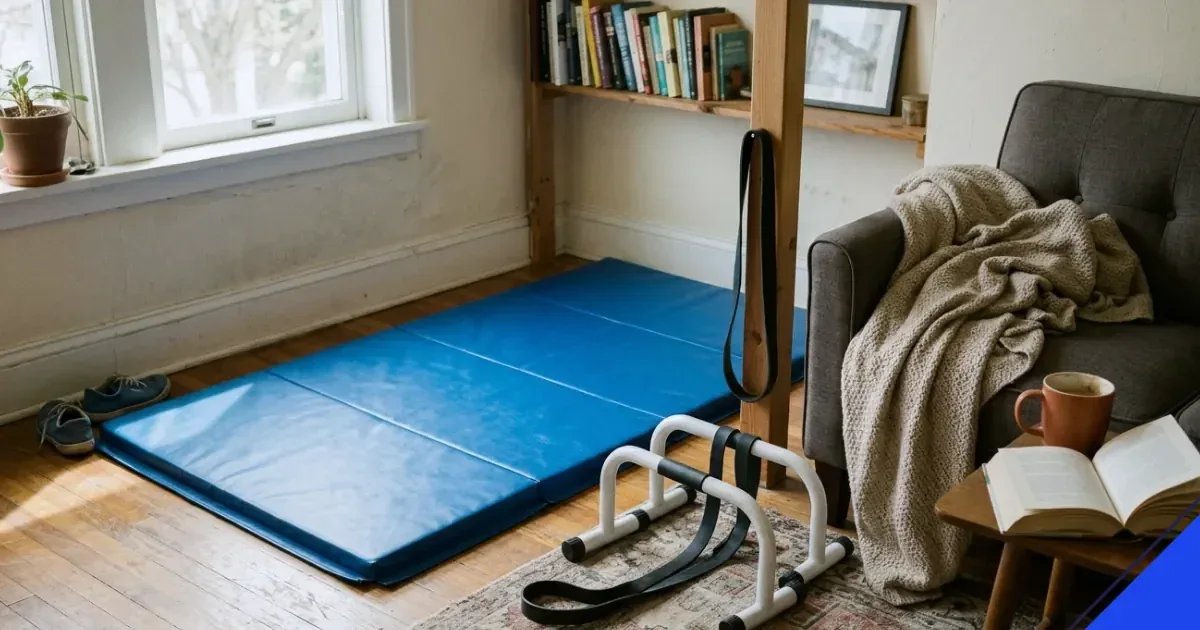
Every home setup begins with a mat that absorbs impact without bottoming out. Yoga mats and exercise mats are too thin to protect wrists, ankles or your head during rolls and handstands. Look for mats sold specifically for gymnastics or martial arts, at least 5 centimetres thick, large enough that you can land a cartwheel without stepping off the edge.
Folding mats store more easily than roll-up types in small homes. If the mat slides on your floor, a sheet of rubber mesh underneath stops it moving mid-skill. A second thinner mat can sit on top for conditioning work, but the thick base mat does the real work.
Practical steps to set up your space safely
Before you buy anything, prepare the room itself. Clear furniture far enough that a failed handstand will not put a foot through a screen or knock over a lamp. Check the ceiling height with your arms fully extended overhead while standing on the mat—you need clearance for jumps and the top of a cartwheel.
- Measure your mat area and mark it on the floor with low-tack tape so you know your safe landing zone before you start a skill.
- Remove anything breakable, sharp or heavy from the training space and from shelves at shoulder height or above.
- Check that the floor itself is level and that the mat lies flat without lumps or folds that could catch a foot.
- Keep a chair or sturdy box nearby for balance support during stretches and early progressions of new skills.
Flooring underneath matters more than most people expect
Carpet cushions falls better than hard flooring, but a thick gymnastics mat on concrete or laminate still works if the mat itself is dense enough. Wooden sprung floors are ideal but rare outside gyms. Avoid practising directly on tiles or stone without a mat—the impact travels straight into your joints.
What a wall bars unit adds to your training
Wall bars, also called a stall bar or Swedish ladder, bolt to the wall and give you an anchor for stretching, conditioning and balance drills. You can work active flexibility, leg lifts, assisted handstands and supported bridges on them. They cost more than most other home equipment but last decades and expand what you can practise without a partner.
A doorway pull-up bar covers some of the same ground—hanging, hollow holds, active shoulder work—and costs far less. It will not help with splits or bridges, but for upper-body conditioning it does the job. Make sure whichever bar you choose is rated well above your body weight and that the doorframe or wall can take the load.
Choices and options for building strength and flexibility
Resistance bands handle most conditioning work that gymnasts need at home. A set with different resistances lets you progress exercises as you get stronger. Use them for shoulder and wrist warm-ups, assisted stretches, and adding load to squats and planks. They pack into a drawer and cost a fraction of a weights set.
Parallettes—low handles that sit on the floor—train wrist strength, L-sits, tuck holds and the shapes you need for more advanced floor skills. You can build a pair from plumbing pipe for less than the price of a commercial set, or start with sturdy books or yoga blocks to practise the same positions until you know you will use them regularly.
| Equipment | What it trains | Improvised alternative |
|---|---|---|
| Wall bars | Flexibility, leg lifts, balance support | Doorway bar for upper body, chair back for stretches |
| Resistance bands | Conditioning, warm-up, assisted stretches | None reliable—bands are already the budget option |
| Parallettes | Wrist conditioning, holds, tuck shapes | Thick books, yoga blocks, homemade pipe set |
| Panel mat | Raised surface for drills, incline work | Firm sofa cushions stacked and secured with tape |
Panel mats and wedges serve specific drills
A panel mat folds into a raised block or wedge and helps with roll entries, handstand shaping against an incline, and drills that need a small height change. Most home gymnasts can skip this unless they are working on a particular skill that a coach has suggested a wedge for. The same money often goes further on private coaching or open gym time where full apparatus is available.
Common mistakes people make when buying for home
Buying a beam for home practice sounds appealing, but floor beams are bulky, expensive, and most skills you would practise on one can be rehearsed on a line of tape on the floor first. The same applies to spring floors, tumble tracks and any piece that mimics competition apparatus—they rarely fit in a home and they gather dust once the novelty fades.
Avoid equipment marketed at children with bright colours and low weight limits. Adult beginners and teenagers need apparatus rated for adult body weight, even if the marketing calls it a kids' item. Check the load rating in kilograms, not the age recommendation. Anything that wobbles, tips or flexes under your weight will teach poor technique and risks injury.
Mirrors are useful but not essential
A full-length mirror helps you check body positions during stretches and conditioning, but filming yourself on a phone propped against a wall does the same job and lets you watch the video back in slow motion. If you do buy a mirror, make sure it is shatterproof or mounted well away from where you might fall into it.
What you can skip or improvise without losing progress
Chalk, grips and wrist supports matter for apparatus work on bars and rings, but at home on the floor you do not need them. If your hands sweat during handstands, wash them before training or use a light dusting of baby powder. Save the expense of grips for when you train regularly on bars.
Specialist gymnastics clothing makes no difference to home practice. Train in whatever lets you move freely and does not catch on equipment—leggings, shorts, a fitted T-shirt. Bare feet give you better feedback and grip than socks or shoes for floor work. Ankle or wrist supports should only be used if a physiotherapist or coach has recommended them for a specific issue; wearing them preventively often weakens the joints they are supposed to protect.
Where to go next once your space is ready
Once the mat is down and the space is clear, the next step is building a warm-up routine you will actually do before each session. Wrist circles, ankle rolls, a few minutes of light cardio and dynamic stretches prepare your body better than launching straight into a handstand. Conditioning exercises—hollow holds, planks, leg lifts—build the strength that makes skills feel lighter and safer.
Training at home works best when it complements coached sessions rather than replacing them. Use home practice for flexibility, conditioning, and rehearsing skills you have already learned with a coach. Trying entirely new skills alone, without someone to spot you or correct your shape, risks injury and ingrains poor technique that takes months to undo.
Download PDF: Home gymnastics space safety checklist PDF, 29 KB
Further reading
Frequently asked questions
How thick should a gymnastics mat be for home use?
At least 5 centimetres thick, made for gymnastics or martial arts rather than general exercise. Thinner mats do not absorb impact well enough to protect your joints during rolls, handstands and landings.
Can you practise gymnastics on carpet without a mat?
Carpet alone does not give enough cushioning for anything beyond very light stretching. Even on carpet, you need a proper gymnastics mat for rolls, handstands and any skill that involves impact.
What can I use instead of wall bars at home?
A doorway pull-up bar handles upper-body conditioning and hanging drills. For stretches and balance support, a sturdy chair back works. Neither replaces wall bars completely, but both cover a lot of the same training.
Do adults need the same equipment as children for home gymnastics?
Adults need equipment rated for adult body weight, regardless of how it is marketed. Check the load rating in kilograms rather than the age recommendation, and avoid anything that wobbles or flexes under your weight.
Is it worth buying a balance beam for home practice?
Most people find a floor beam too bulky and expensive for the amount they use it. Practising beam skills on a line of tape on the floor builds the same balance and muscle memory without the cost or storage problem.