Acrobatic gymnastics brings together balance, dynamic throws and three roles you share with a partner
 Save
Acrobatic gymnastics is the discipline in which you work with a partner or a group to build human pyramids, throw and catch one another, and perform tumbling sequences as a unit. The person on the floor supports the weight; the person in the air holds the shape. You are reading Astral Acrobatics, and this guide explains the structure of the discipline, the skills you practise and the way a routine is put together.
Acrobatic gymnastics is built around partnerships, not solo work
You never perform alone in this discipline. A routine involves a pair, a trio or a group of four, and every move depends on timing and trust between you and the people you work with. One person lifts, steadies or throws; another person balances, twists or lands.
The categories are fixed by size and sometimes by gender. A women's pair has two women. A men's pair has two men. A mixed pair has one man and one woman. A women's group has three women, and a men's group has four men. Each category competes separately.
In practice: You train with the same partner or group for months, often years. The relationship is closer to a dance partnership than to the solo preparation most people associate with apparatus work.
The roles of base and top decide who lifts and who flies
Every partnership divides into base and top. The base stays on the floor, bears the load and provides the platform. The top climbs, balances or is thrown into the air. In a trio or group, one or two people act as base and the others as tops, though the split is not always absolute—some moves ask a base to become a temporary top.
A base needs strength, stability and the ability to hold a position under load. A top needs body control, spatial awareness and the confidence to invert or leave the ground entirely. Neither role is easier; they simply ask for different qualities.
| Role | What you do | What you need |
|---|---|---|
| Base | Support, lift, catch | Strength, stillness, timing |
| Top | Balance, twist, fly | Body control, trust, awareness |
Choosing which role suits you comes down to your build, your training background and what feels natural when you first try. Many people discover their role in their first session.
Balance skills hold a static shape for a set number of seconds
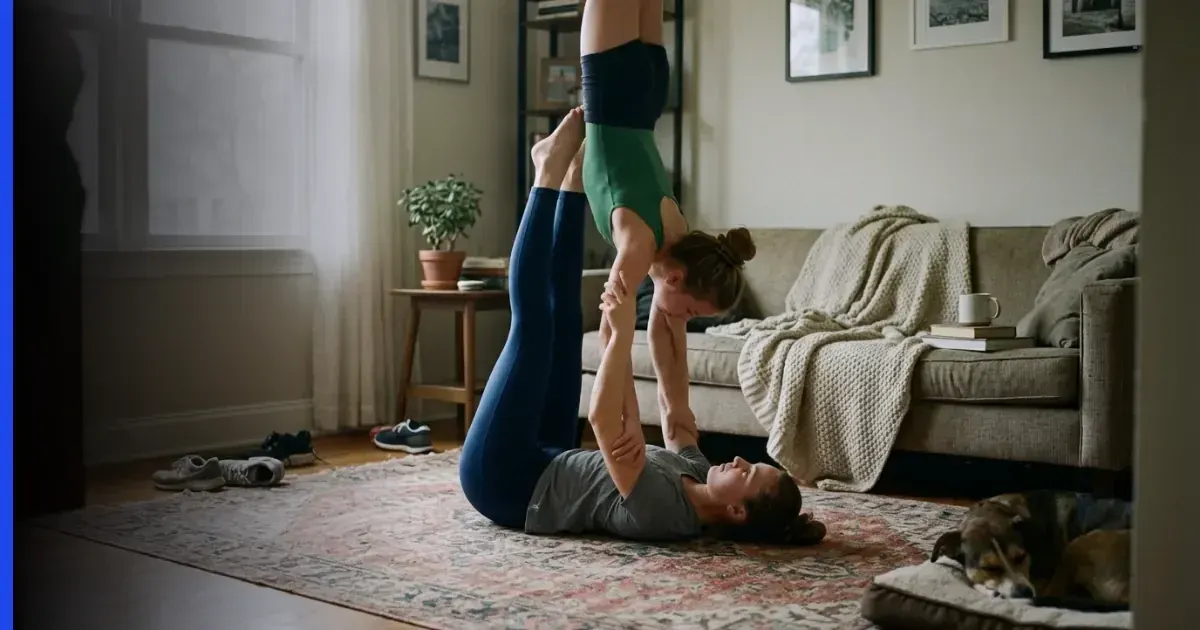
A balance is any move in which the top holds a position on the base without moving for a required duration. The base remains still as well. A handstand on your partner's shoulders is a balance. A split held above your partner's extended arms is a balance. A one-armed plank on your partner's back is a balance.
The difficulty rises with the number of contact points, the height of the top and the complexity of the shape. A two-handed grip on the floor is easier to stabilise than a one-handed grip on the base's thighs. Judges look at the line of the body, the steadiness of the hold and whether the required time is met.
You build these moves in stages. You start on the floor with a spotter, then move to a low platform, then to your partner's hands or shoulders. Each stage asks you to trust the base a little more and to hold your own shape a little longer.
Common balance progressions you practise early
- Front support: the top lies face-down across the base's thighs or shoulders, body straight
- Shoulder stand on feet: the top inverts, balancing on the base's feet while the base lies on their back
- Counterbalance hold: both partners lean away from a shared grip, creating tension
Dynamic skills involve flight, rotation and a controlled catch
A dynamic move is one in which the top leaves the base, travels through the air and is caught—either by the same base or by another member of the group. These skills bring the highest risk and the loudest reaction from an audience. A well-timed throw and catch can look effortless; in reality it demands precision to the fraction of a second.
The base generates the force by pushing upward or releasing a held position at the exact moment the top jumps or extends. The top rotates, twists or pikes in the air, then prepares to land in the base's hands, on their shoulders or back on the floor. The catch absorbs the impact and brings the top to a controlled stop.
Worth remembering: You drill the timing on a soft surface with a coach nearby before you attempt the full skill. The base learns to watch the top's centre of mass, not their hands or feet. The top learns to spot the landing and to stay tight throughout the rotation.
Examples of dynamic skills by difficulty
A pitch toss sends the top upward in a straight line; they land back in the base's hands. A somersault to catch adds a forward or backward rotation before the catch. A twisting layout combines a straight body position with a half-turn or full turn in the air. Each skill has a difficulty rating, and you select them to meet the requirements of your routine.
Tumbling runs connect acrobatic gymnastics to floor exercise
Every routine includes a tumbling section in which one or more members of the group perform a sequence of flips, twists and rolls across the floor. This portion looks identical to the tumbling in artistic gymnastics: round-offs, back handsprings, layouts, full twists. The difference is that in acrobatic gymnastics, the tumbling is synchronised between partners or woven into the transitions between balance and dynamic skills.
You practise these skills separately, then bring them into the routine once they are consistent. A pair might perform matching tumbling passes side by side, or one partner might tumble while the other prepares the next balance position.
Choreography and music shape the routine into a performance
A competition routine runs for a set time and is performed to music. You choose the music, and you design the choreography to match its rhythm and mood. The moves must flow from one to the next without long pauses, and every element—balance, dynamic, tumbling—must appear in the order the code of points requires.
Judges award marks for execution, artistry and difficulty. Execution covers the precision of your shapes, the control of your landings and the stability of your balances. Artistry looks at the musicality, the expression and the way you use the floor. Difficulty is the sum of the rated skills you perform.
In short: A routine is not a collection of tricks. It is a choreographed piece in which each skill has a reason and a place.
Training happens in a gym with mats, a sprung floor and a coach
You train on a padded floor or a spring floor, the same surface used for artistic gymnastics. You also use panel mats to raise the landing height while you learn new dynamics, and you work with a coach who spots the skills until they are safe to perform independently.
Sessions include strength and conditioning work for the base, flexibility and body-tension drills for the top, and partner drills in which you practise lifting, gripping and catching without attempting the full skill. You also spend time on tumbling progressions, which you can work on alone or in parallel with your partner.
What a typical session covers
- Warm up with joint rotations, light cardio and dynamic stretches for the whole body
- Drill individual skills on the floor or with a spotter: handstands, press-ups, core holds
- Practise balance moves with your partner, starting from the simplest entry
- Attempt dynamics on a soft surface, focusing on timing rather than height
- Run through sections of your routine, linking two or three skills at a time
- Cool down with static stretches and a brief review of what worked
Choosing acrobatic gymnastics if you prefer working with others
This discipline suits you if the idea of solo work feels isolating or if you enjoy the problem-solving that comes from coordinating with another person. It rewards communication, patience and the ability to trust someone else with your safety. You might find it appealing if you have a background in partner dance, martial arts or any sport in which timing with another person matters more than individual speed.
It also suits you if you want to compete but lack the apparatus skills that artistic gymnastics demands. Acrobatic gymnastics asks for strength, control and spatial awareness, but it does not require you to swing on bars or vault over a table. The floor is the only apparatus you use.
If you are curious about how other gymnastics disciplines differ, read our guide to the five types of gymnastics and what makes each one distinct. For advice on beginning as an adult, see how to start gymnastics as an adult. To prepare your body for any discipline, consult our page on warming up properly before gymnastics.
Start practising the foundations this week
You do not need a partner to begin. The strength, flexibility and body control you build now will serve you the moment you start working with someone else.
Hold a handstand against a wall for ten seconds each day, focusing on keeping your body straight and your shoulders pushed down. Practise hollow holds on the floor for three sets of twenty seconds, pulling your belly button toward your spine. Work on your splits and your bridge so that when a balance asks for a deep line, your body is ready. Find a local gymnastics club that offers acrobatic classes and ask to observe a session before you commit.
Download PDF: Your first steps into acrobatic gymnastics PDF, 29 KB
Further reading
Frequently asked questions
What is the difference between acrobatic gymnastics and artistic gymnastics?
Acrobatic gymnastics is performed in pairs or groups, with partners lifting, balancing and catching one another. Artistic gymnastics is performed solo on apparatus such as bars, beam and vault. Both include floor work and tumbling, but acrobatic gymnastics has no apparatus beyond the sprung floor.
How do you know if you should be a base or a top?
The base role suits people with strength, stability and a heavier build, as they support and lift the load. The top role suits those with body control, flexibility and a lighter frame, as they balance and fly. Most people discover their natural role within the first few sessions by trying both.
What age can you start acrobatic gymnastics?
Many clubs accept children from around six or seven years old, once they have the coordination to follow instructions and work safely with a partner. Adults can start at any age, though finding a partner of similar experience and training availability is often the first step.