Upper body strength for gymnastics: four muscle groups that carry you through rings, bars and floor work
 Save
Upper body strength in gymnastics means the ability to push, pull and hold your bodyweight in positions that feel unnatural at first. Astral Acrobatics breaks down the muscle groups you need, the exercises that build them, and the progression routes that take you from your first supported hold to skills you thought belonged to someone else. You'll finish this page knowing where your training time goes and which exercises earn their place.
Shoulders carry most of the load in inverted work
Your shoulders stabilise you when your hands are the base and your feet are in the air. The deltoids — front, side and rear — work with the rotator cuff muscles to keep the joint centred under load. Gymnasts spend time upside down, and weak shoulders give out before your arms or core do.
Pike push-ups shift weight onto your shoulders without inverting you fully. Start with your hands on the floor, hips high, and walk your feet closer until your body forms a rough right angle. Lower your head towards the ground, then press back up. Move your feet closer as you get stronger.
Handstand holds against a wall teach your shoulders to support your full weight. Kick up so your heels touch the wall, arms straight, and hold for time. When that feels steady, try moving one heel away from the wall for a few seconds. Scapular push-ups in a handstand — small presses from the shoulders without bending the elbows — build the fine control rings demand.
Pushing strength comes from chest and triceps working together
Chest and triceps generate the force that moves you away from a surface. Press-ups, dips and planche progressions all draw on these muscles. Gymnasts need endurance here — skills rarely happen once.
Press-ups remain useful long after you can do twenty in a row. Narrow your hand position to load the triceps more heavily. Elevate your feet to increase resistance. Archer press-ups — shifting your weight to one side as you descend — prepare you for one-arm work later.
Parallettes or low parallel bars let you practise dips and L-sits in one piece of equipment. Dips build the lockout strength you use at the top of every press. L-sits teach you to hold a static shape while your arms push down hard. Start with bent knees if a straight-leg hold is out of reach.
Pulling strength lets you lift and control your body on bars and rings
Your back and biceps pull you upwards and hold you in place when gravity wants you to drop. Rows, pull-ups and front lever progressions build the strength bars and rings require. Pulling work also balances the pressing exercises most people do more of.
Horizontal rows using a low bar or rings teach the movement pattern before you hang freely. Lie underneath, grip the bar, and pull your chest to it while keeping your body straight. Raise the bar as you get stronger, or lower it to make the exercise harder.
Pull-ups and chin-ups are the standard for a reason. Chin-ups — palms facing you — recruit the biceps more and feel easier at first. Pull-ups — palms away — load the back more heavily. Negatives help when you can't yet pull yourself up: jump to the top position and lower yourself as slowly as you can. Strength builds faster on the way down.
Front lever progressions demand patience and consistent work
The front lever is a horizontal hold under a bar, body straight, face up. Tuck your knees to your chest and hold that shape first. Extend one leg when the tuck feels solid. Advance to a straddle, then to the full position. Each step may take weeks or months. Wrist conditioning runs alongside this work — the angle and load on your wrists increase as you progress.
Core stability connects your upper and lower body through every skill
Your core transfers force between your limbs and keeps your body aligned when it's easier to sag or arch. Hollow holds, planks and compression drills prepare you for the shapes gymnastics asks for. A weak core makes everything harder and less controlled.
The hollow hold is the single most gymnastics-specific core exercise. Lie on your back, press your lower back into the floor, lift your shoulders and legs a few inches, and hold. Your body forms a shallow dish. This is the shape you hold in the air during many skills. When the basic hold feels manageable, try hollow rocks — rocking back and forth without changing the shape.
Compression work — pulling your knees or straight legs towards your chest while seated or hanging — builds the strength you need for pike shapes and for lifting your legs quickly. Seated pike lifts are a good start: sit with legs extended, place your hands beside your hips, and try to lift your legs off the ground while leaning back slightly.
Bodyweight exercises progress when you change leverage, not when you add repetitions
Doing fifty press-ups builds endurance, but gymnastics demands strength at awkward angles and in held positions. Progress by making the exercise harder, not longer. Move your hands closer together, elevate your feet, shift to one arm, or slow the movement down.
Isometric holds — staying still in a difficult position — suit gymnastics better than high-repetition sets. A thirty-second L-sit builds more relevant strength than a hundred sit-ups. Rings amplify every exercise because they move, forcing your muscles to stabilise as well as push or pull.
| Exercise type | Progression method | When to move on |
|---|---|---|
| Push-ups | Elevate feet, narrow hand position, single-arm variations | When you hold good form for the full set |
| Isometric holds | Extend hold time, then change body angle | When the current hold feels controlled for the target duration |
| Pull-ups | Add pause at top, slow the descent, try one-arm negatives | When the movement feels smooth and you're not swinging |
| Lever progressions | Tuck to single leg to straddle to full extension | When you can hold the current shape without shaking for several seconds |
Training frequency and rest shape your results as much as the exercises do
Strength training for gymnastics works best when you train the same movements several times a week, not once. Your nervous system learns the skill of producing force in specific patterns, and that learning needs repetition. Muscles recover faster than connective tissue, so wrists, elbows and shoulders need days between hard sessions.
A simple structure: train pushing exercises one day, pulling the next, with a rest day after two or three sessions. Each session stays short — thirty to forty-five minutes — because intensity matters more than volume. Warm up thoroughly before you load your joints in challenging positions.
Rings intensify everything and expose imbalances you didn't know you had
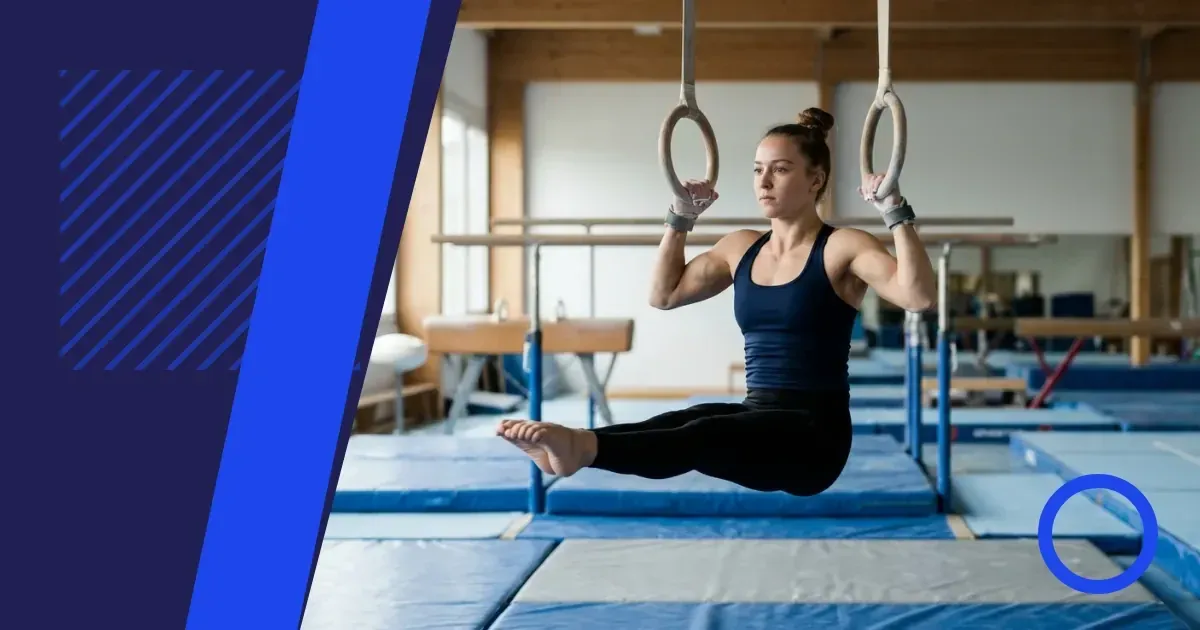
Rings move in every direction, so your stabiliser muscles work harder than they do on a fixed bar. A ring push-up feels different from a floor push-up even when your hands are at the same height. Ring rows teach you to control rotation. Start with the rings set high so your body is nearly upright, then lower them as you improve.
Follow these steps to build a training week that suits the equipment and time you have
You don't need a full gymnastics gym to build upper body strength. A pull-up bar, a set of rings you can hang in a doorway or from a tree, and a few square feet of floor space cover most of what matters. Here's how to organise your week:
- Choose one pushing exercise, one pulling exercise and one core hold for each session. Pike push-ups, pull-up negatives and a hollow hold make a complete session. Keep the exercises few and the focus sharp.
- Warm up with joint rotations and light movement before you attempt a hold or a maximum effort. Cold connective tissue tears more easily than warm tissue. Spend five minutes on wrist circles, arm swings and a few easy reps of the exercise you're about to load.
- Train three or four days a week, alternating push-heavy and pull-heavy days. Your shoulders and elbows recover better when you don't load them in the same pattern every day. A simple split: push and core on Monday, pull and core on Wednesday, push on Friday.
- Add one new progression every few weeks, not every session. Your connective tissue adapts more slowly than your muscles. When an exercise starts to feel easy, stay with it for another week or two before you make it harder. Patience prevents injuries that wipe out months of progress.
- Record what you did — exercise, sets, hold times or repetitions — so you know whether you're moving forward. A simple notebook or a notes app works. Progression is easier to see when you write it down.
Skill-specific strength matters more than general fitness
A gymnast's upper body strength is trained through the shapes and ranges gymnastics uses. A bench press builds your chest, but it won't teach your body to stabilise in a handstand or hold a planche. The closer your training mimics the demands of the skills you want, the faster those skills arrive. Bodyweight exercises in the positions gymnastics requires build strength that transfers directly to apparatus work.
This is why basic gymnastics skills and strength conditioning feed each other. Working on a handstand builds shoulder strength; stronger shoulders make the handstand more stable. The loop tightens with every session.
Start with the easiest version of each exercise and progress when form is solid
Good form means you control the movement from start to finish without compensating — no sagging hips in a plank, no kipping in a pull-up, no flared elbows in a dip. Poor form under load teaches your body the wrong pattern and sets you up for an injury when the load increases. If you can't hold the shape, make the exercise easier. There's no shame in stepping back; there's cost in pushing through.
Progressions exist for every exercise. Can't do a pull-up? Do negatives. Can't hold a hollow shape with straight legs? Bend your knees. Can't press to handstand? Work pike push-ups and wall holds. Each step prepares you for the next one. Skipping a step means you'll stall later or hurt something trying.
Download PDF: Upper Body Strength Training Checklist for Gymnasts PDF, 29 KB
Further reading
Frequently asked questions
How long does it take to build enough upper body strength for gymnastics?
It depends on where you start and how often you train. Someone new to bodyweight training who works three or four days a week will usually see noticeable progress in handstands, basic holds and pull-ups within two to three months. Advanced static holds and lever progressions often take six months to a year or more.
What exercises build strength for handstands fastest?
Pike push-ups, wall-facing handstand holds, and scapular push-ups in a handstand position all target the shoulders and core stability a handstand requires. Wrist conditioning and hollow hold work should run alongside them, because weak wrists or a sagging core will limit your progress before your shoulders do.
Can you train gymnastics strength at home without equipment?
Yes. Press-ups, pike push-ups, handstand work against a wall, hollow holds and plank variations all build relevant strength with no equipment. A pull-up bar or a set of rings opens up pulling exercises and significantly expands what you can train, but you can start and make real progress with floor work alone.